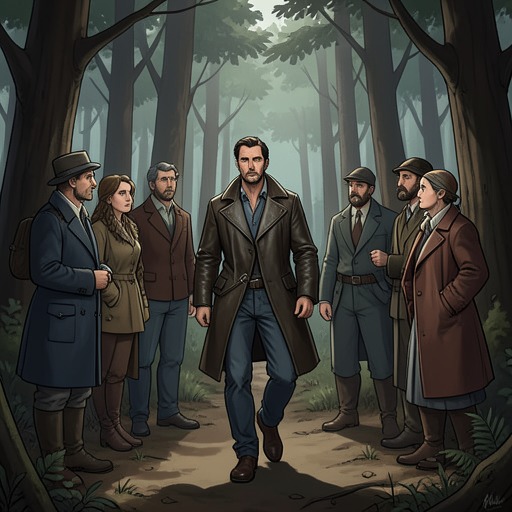
Servants of the Inner Circle
The Deer KingThe Servants of the Inner Circle are the inherited human network behind the Inner Circle’s political reach: families serve across generations, gathering information and sustaining relationships that outlast the governments under which they were formed. Their work makes them both agents of a hidden institution and a bridge between the Otawalle, the rulers of Aquafa, and local groups such as the Molfah.
Origins and Structure
The Shinock family had served the Inner Circle for centuries. Its eldest son was expected to enter that service, and Makokan’s father accepted this duty from youth. Within the clan, he was respected as a nobleman knowledgeable about the outside world. Makokan’s older brother and sister were trained for the work from childhood and became secret agents who traveled extensively. Their rare visits made them mysterious and warmly welcomed figures to their much younger brother.
Makokan, the second son, was trained instead by his grandfather and uncle, both retired from Inner Circle service. Had events not intervened, he was expected to travel to the Sacred Territory of Otawalle at fifteen, pledge allegiance to the sacred houses, and begin serving the organization. The family’s service was therefore not simply an occupation: it was a prescribed path passed down through generations, with children prepared for particular roles well before adulthood.
Methods and Political Reach
The Inner Circle’s network gathered information throughout the Kingdom of Aquafa, extending, in the account’s image, like a spider’s web. Although the Otawalle relinquished direct government, they retained the organization and supplied successive Aquafa rulers with information, continuing to influence political affairs from behind the scenes. The Servants were the human infrastructure that allowed this intelligence network to reach beyond the Sacred Territory.
The network’s reach depended on durable ties rather than formal authority alone. The Molfah, once entrusted with capturing thieves and spies for the Aquafa king, continued to be known for their formidable tracking. Hohsalle identified them as the Aquafa Slave Trackers and maintained a connection with their leader, Malji; his grandfather, Limuelle, personally treated Malji’s seriously ill eldest son. Makokan recognized the broader implication: the Otawalle still made covert use of trackers they had once governed, so old relationships of control survived Aquafa’s subjugation to the Zolian Empire.
The connections also served the new imperial administration. Yotalu knew of the Otawalle and Molfah networks and used both for the Zol Empire. At the same time, Zolian tax officers collected detailed information about nomadic groups in outlying regions, including the Oki Valley and the Toga Mountains, recording populations and ages. Yotalu proposed that these records could help establish how many people lived in the areas where the disease was spreading, while acknowledging that some people hid from tax collectors. In this setting, intelligence gathering could support both political oversight and an urgent public-health response.
People, Access, and Operations
The organization’s hierarchy restricted access to its leaders. During a visit to the Academy of Deeper Learning, Hohsalle judged that Makokan had been startled by the presence of Cheehana, who commanded the Servants of the Inner Circle. People of lower rank were not permitted an audience, and most did not know that Cheehana was a woman. She ran the academy behind the scenes, while the public-facing director, Rotoman, received the visitors alongside her.
The organization’s methods were not limited to formal audiences or written reports. In a camp, Mulyo summoned young men with a brief hand gesture; they took the visitors’ horses without her needing to speak. The moment shows a practiced chain of response in which a small signal was enough to set others moving. Elsewhere, the network’s capacity to send someone to investigate the Gansa and neighboring clans in the Toga Mountains demonstrates that it could direct inquiries across difficult political and geographic terrain.
Crisis and Significance
The Inner Circle’s intelligence work entered a crisis when attacks on the royal falcon hunt and the salt mine raised suspicion that the beasts’ actions might be planned rather than random. After hearing Makokan’s account of the attack that befell Sae, Cheehana observed that an assault from a cliff seemed unnatural. She reasoned that someone might be trying to prevent the capture of the escaped Gansa slave who had survived the disease, and considered whether the Gansa clan was involved. The Inner Circle had already dispatched an investigator to the Toga Mountains, but the Gansa and neighboring clans remained guarded. Cheehana also cautioned that a sustained strategy would require organization and that the Inner Circle could not cover every mountain and forest.
This uncertainty mattered politically: the Toga Mountains were a defensive barrier against invasion from Mukonia, with many Zolian troops stationed there, so rebellion in the region would be especially dangerous. The Servants’ network could gather information and connect distant actors, but it could not make incomplete intelligence certain. Its significance lies in that tension. The Inner Circle’s influence survived successive regimes because its people, loyalties, and information channels persisted beneath visible political change; in moments of crisis, those same channels became tools for investigation, negotiation, and imperial administration.